

Is Hard Work Really the Antidote to Poverty?
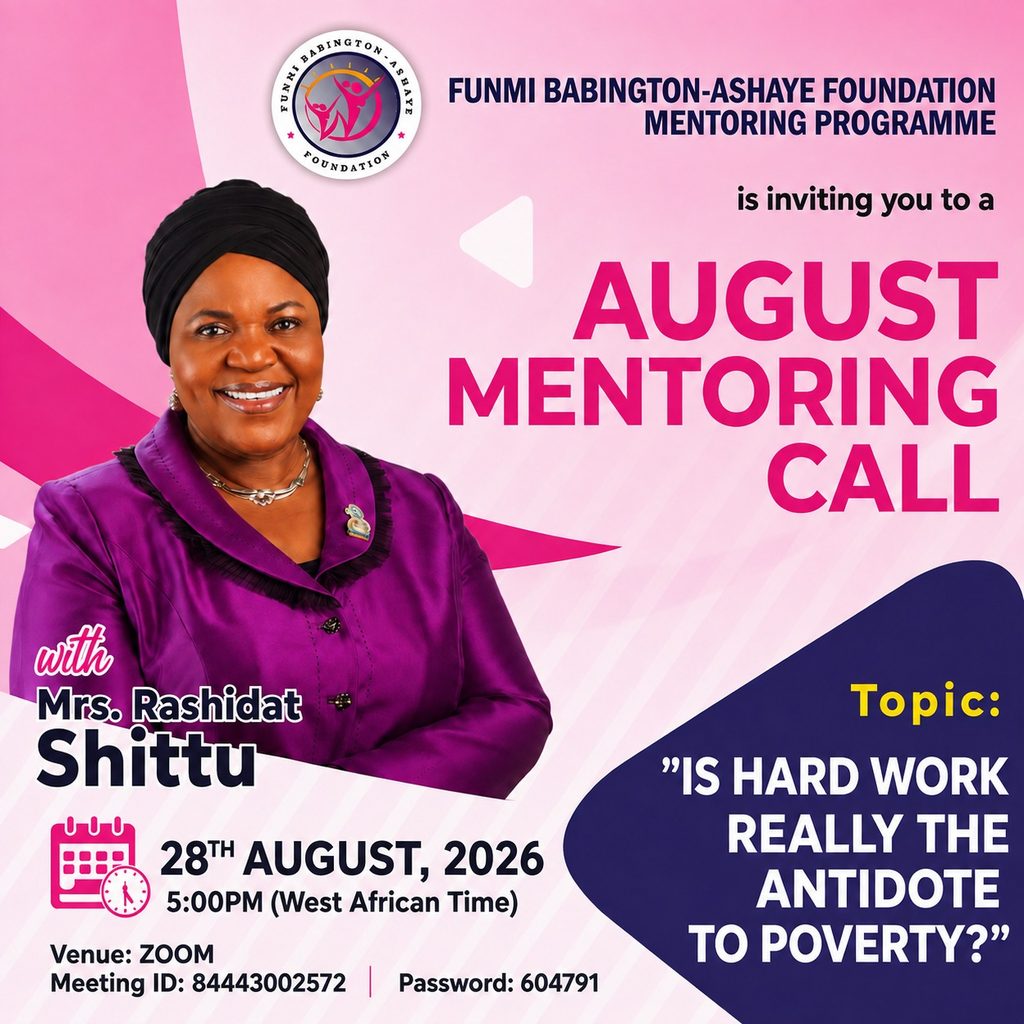
Is hard work really the antidote to poverty?”
That was the thought-provoking question at the heart of the recent FBA Mentoring Programme session, where Mrs. Rashidat Shittu, an accomplished insurance professional, entrepreneur and mentor, shared her remarkable life journey and the lessons she has gathered along the way.
Her story was not simply about professional success. It was a story of humble beginnings, family responsibilities, delayed dreams, perseverance, faith, education, resilience and the determination to keep moving forward despite life’s many obstacles..
A Humble Beginning
Mrs. Shittu’s story began with her mother, a visionary clothes seller and mother of seven children, five of whom were girls.
At a time when her father did not believe strongly in educating female children, her mother refused to allow circumstances to determine the future of her daughters. She pleaded with her husband for permission to educate them, insisting that she could afford to take responsibility for their education herself.
Her mother’s motivation was partly inspired by the educated women who patronised her clothing business—nurses, teachers, lawyers and entrepreneurs. She admired these women and dreamed of seeing her own daughters become professionals.
Her determination paid off.
The daughters went on to pursue different careers. One became a nurse, another a teacher, while Mrs. Shittu eventually built a career in the insurance industry.
Her mother’s message was simple but powerful:
Education could change the trajectory of their lives.
A Dream Deferred, But Never Abandoned
As a young girl, Mrs. Shittu dreamed of becoming a lawyer. Her inspiration came from a lawyer who was one of her mother’s customers and whom she admired greatly.
However, life did not immediately follow the script she had imagined.
After secondary school, she secured her first job at a medical centre. Although she had an opportunity to pursue further training in dental therapy, her parents did not support the idea.
Rather than abandon her desire to build a better future, she took another path. She enrolled in a teacher training college and obtained a Grade II teaching certificate.
Soon after, family expectations came into play. She got married at the age of 20 and became a mother of two daughters.
Her dreams had not disappeared. They had simply been placed on a different timeline.
Finding Her Way Into Insurance
Mrs. Shittu’s journey into the insurance industry began in June 1985 when a family friend introduced her to Olympia Insurance.
She worked there for four years before moving to Amicable Insurance, where her professional journey in insurance began to take shape.
Despite coming from a background that did not provide her with extensive formal education, she decided to pursue professional insurance qualifications.
What followed was an 11-year journey, She eventually qualified in 2003.
It was not an easy journey. But it taught her one of the most important lessons she would later share with the mentees:
Progress does not always happen according to the timetable you create for yourself.
When Dreams Have to Wait
Her hunger for education did not end with her professional qualification.
She gained admission to the University of Lagos to study English Language. However, balancing university education, professional examinations, motherhood and raising two children became extremely difficult.
Eventually, she had to leave the university and focus on her career and her family.
But giving up on her personal education did not mean she had given up on education itself.
Instead, she poured that dream into her children.
She was determined that what she could not accomplish in the way she initially imagined, her children would have the opportunity to accomplish.
Today, her daughters have gone much further academically, with one holding a PhD and the other possessing two master’s degrees.
For Mrs. Shittu, that was also a form of success.
Knowing Yourself: The Power of Personal SWOT Analysis
One of the major lessons from Mrs. Shittu’s story was the importance of self-awareness.
She encouraged mentees to conduct a personal SWOT analysis by identifying their:
- Strengths
- Weaknesses
- Opportunities
- Threats
Strengths
Mrs. Shittu identified qualities such as resilience, empathy, adaptability, discipline, teamwork and sociability as important strengths.
She also described herself as a strong problem solver who values honesty, loyalty and reliability.
These qualities, she explained, gave her an advantage throughout her career and helped her navigate difficult situations.
Weaknesses
She was equally honest about her weaknesses.
These included procrastination, overcommitment, fear of the unknown and anxiety around public speaking.
Her fear of the unknown, for example, contributed to her staying with one employer for many years because she was hesitant to take a risk and explore something different.
The lesson was clear:
Knowing your weaknesses is not a sign of failure. It is the first step towards improving them.
Opportunities
Opportunities can come through education, networking, mentorship, volunteering and learning new skills.
Mrs. Shittu particularly highlighted mentorship as an important opportunity in her own life.
At a certain point, she realised she needed guidance and support beyond what she could provide for herself. That search for mentorship eventually connected her with the FBA Foundation.
Threats
Unlike weaknesses, threats are largely external.
They can include economic changes, workplace restructuring, competition, downsizing and other circumstances beyond an individual’s control.
The important thing is not to pretend these challenges do not exist, but to develop the resilience necessary to navigate them.
The Four Powerful Ps
At the heart of Mrs. Shittu’s message were what she called the Four Powerful Ps:
1. Prayer
For Mrs. Shittu, faith has always been central to her journey.
She explained that she was raised to put God first and that prayer became a foundation for navigating life’s challenges.
Her message was simple:
Do your part, but never forget the place of God.
2. Perseverance
Perseverance is the ability to keep going when circumstances become difficult.
Her own 11-year professional qualification journey is evidence of this.
While some people completed similar journeys in four or five years, she continued for 11 years until she achieved her goal.
The lesson?
A delayed result is not necessarily a denied result.
3. Patience
Mrs. Shittu also emphasised patience.
Not everyone will achieve their goals at the same speed.
Some people will graduate earlier. Some will build careers earlier. Some will become leaders earlier.
But another person’s timeline should not become the standard by which you measure your own life.
4. Purpose
The final P is purpose.
She encouraged mentees to keep their eyes on the goal.
Challenges will come. Distractions will come. Delays will come.
But knowing what you are pursuing makes it easier to remain focused when the journey becomes difficult.
Keep your eyes on the ball.
So, Is Hard Work Really the Antidote to Poverty?
After sharing her story, Mrs. Shittu returned to the central question.
Her answer was nuanced.
Hard work is important, but hard work alone is not enough.
She explained that discipline, adaptability, integrity, relationships, mentorship, personal development and an inner drive to keep growing all play important roles.
Hard work may get you moving, but what you build along the journey determines how far you can go.
She summarised the idea powerfully:
Character shapes us. Persistence keeps us. Mentorship expands our vision. Opportunity gives room for effort to flourish. Divine grace ultimately shapes the destination.
Your beginning may explain why you started late, but it does not have to determine where you finish.
Hard Work vs. Smart Work
During the question-and-answer session, one of the mentees asked about the difference between working hard and working smart.
Mrs. Shittu acknowledged that hard work is important, but working smart can give someone an advantage, particularly when combined with support, guidance and the ability to recognise opportunities.
Other mentors expanded on the point.
Mrs. Onanuga explained that a person can work extremely hard without making meaningful progress if there is no clear destination.
Working smart means understanding the goal, finding efficient ways to achieve it and recognising that time matters.
Mrs. Akudo Abengowe added that setting timelines is an important part of working smart.
For example, someone pursuing a degree should have an idea of when they hope to complete it. Timelines create focus and help people measure progress.
She also emphasised the importance of taking advantage of opportunities and networking with people who can provide access to rooms and opportunities that hard work alone may not open.
What About Connections?
Another important question emerged:
Do you need connections to succeed?
The answer from the discussion was essentially yes—but with an important qualification.
Connections matter.
Networking matters.
Mentorship matters.
But relationships should not replace competence, preparation and hard work.
One of the mentors pointed out that the ultimate connection, from a faith perspective, is with God. At the same time, God can use people to create opportunities, provide support and open doors.
The FBA Mentoring Programme itself is an example of this.
Mentorship creates connections between women at different stages of their professional and personal journeys, allowing knowledge, experience and opportunities to be shared.
Your Timeline Is Not Everyone’s Timeline
Perhaps one of the most powerful parts of the session came when Mrs. Shittu spoke about delayed success.
She shared that she once went to law school expecting to be called to the Bar alongside her colleagues, but she did not pass at the time she expected.
She did not quit.
Instead, she continued.
Her message to the mentees was that people have different timelines.
Some are early starters.
Some are late starters.
Some start in the middle.
But starting late does not mean finishing badly.
She also warned against allowing self-imposed deadlines to become sources of unnecessary pressure.
Goals and timelines are useful, but life can introduce circumstances beyond our control.
Therefore, while setting targets, we must also cultivate resilience, perseverance and patience.
Success Is Personal
Another important lesson from the session was that success does not look the same for everyone.
One mentor pointed out that Mrs. Shittu had, at one point, prioritised the education and development of her children over her own academic ambitions.
By another person’s definition, that might look like a detour.
By her own definition, it was success.
This raises an important question:
What does success actually mean to you?
Is it a particular job title?
A degree?
Financial independence?
Raising successful children?
Building a business?
Serving others?
Becoming a leader?
There is no universal answer.
Each person must define what success means to them and then build towards it.
The Importance of Visibility, Leadership and Communication
The conversation also highlighted the changing nature of the workplace.
Working hard quietly is valuable, but today’s professional environment increasingly requires people to be visible, communicate effectively and demonstrate leadership.
Mentees were encouraged to develop:
- Leadership skills
- Communication skills
- Public speaking abilities
- Teamwork
- Professional visibility
- Networking skills
- The confidence to use their voices
The message was particularly relevant for young women navigating modern workplaces.
It is not enough to be good at what you do. People also need to know what you can do. To learn More Is_Hardwork_the_antidote_to_poverty.pptx